Showing posts with label City Tram. Show all posts

Wednesday, April 27, 2016

Semarang-Joana Stoomtram Maatschappij (SJS), the Pioneer of Steam Tram Development in Indonesia

The emplacement of  Semarang Central Station, owned by Semarang-Joana Stoomtram Maatschappij (SJS) in 1920. This central station served the city tram services as well as external lines to the cities to the east of Semarang. Unfortunately, nothings remains from this station after demolished in 80's decade. Source: Tropenmuseum
There was three major railway company in Semarang on the old days, Nederlandsch Indische Spoorweg Maatschappij (NIS), Semarang-Cheribon Stoomtram Maatschappij (SCS) and Semarang-Joana Stoomtram Maatschappij (SJS). NIS was the leading company at that time, its also became the company who built the first railways in Indonesia, or Dutch-Indies at that time. The main office of this company even much famous among the people nowadays, a building called Lawang Sewu means thousand doors. Also became landmark of Semarang city yet popular city destination. How about the rest? The SCS and SJS? Not so many people discussing about this two companies that also served the city of Semarang during the colonial period. After the independence of Indonesia, these company, NIS, SCS and SJS is amongst the eleven private railways company, together with the Staats Spoorwegen, the state railway company merged under Djawatan Kereta Api (DKA) Republik Indonesia on January 1st 1946. Currently the company change the name into PT. Kereta Api Indonesia (KAI).

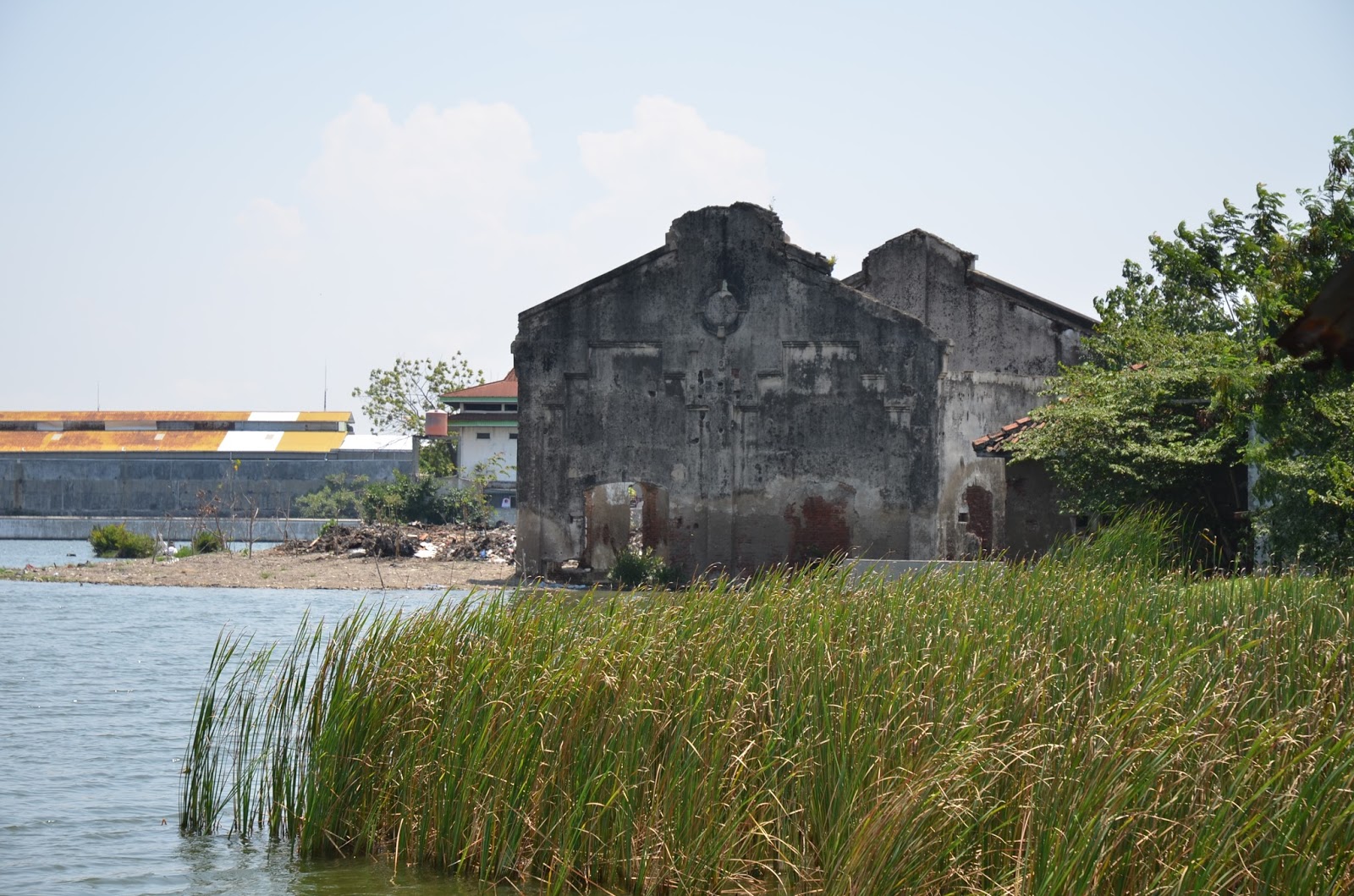
Halte Genoek, the place where the first Buitenlijnen (External lines) 
of SJS Tram services was inaugurated on July 23rd, 1883. The condition is 
getting worse because of land subsidence that can go up to 14–19 cm/year. 
(photos by: Abdul Hakim Nurmaulana)
Now, I'm gonna explain about SJS first, the source taken from the book titled De Tramwegen op Java, issued on 1907 in order to celebrated the 25 anniversary of SJS. SJS established on September 28th 1881 in Gravenhage, Netherlands. This company headed by Mr. M. A. H. Baron van der Goes of Dirxland. Firstly, this company get a concession to built tram network in the area of Semarang until Joana (Juwana) on March 18, 1881. So, SJS is the pioneer of the tram network in Java Island, as well as Indonesia. Seems like this company get a inspiration from the Netherlands which at that time also developed its tramwegen network, and prove as the good commuter services. The SJS also using the narrow-gauge railway, 1067mm. Its different from the NIS at that time that using standard-gauge railway, 1435mm on their line that lies from Semarang-Surakarta-Yogyakarta and also Kedungjati-Ambarawa. Narrow-gauge is thus often used in mountainous terrain, where the savings in civil engineering work can be substantial.

SJS succesfully inaugurated their first line of city tram on December 1st 1882, in Semarang. The network lies between Station Central Jurnatan until Djomblang Station along 5 km. Then not so long from its inaugurated the inter-city tramway connection, start from Semarang until Genoek Station, on July, 23rd 1883 and in the same year its reached Demak, on September, 27th 1883. All of the lines using steam tram locomotives for the rolling stock, because all the lines were designed for the tram locomotives. SJS using such a Beyer, Peacock & Co. trams, that specially built, or modified, to work on a street, or roadside, just like all of the lines condition of SJS have in the beginning. The tram services by SJS were using the B12 series locomotives, produced by NV. Werkspoor from Netherlands and also the same type produced by Beyer-Peacock, England. This locomotief have classification as 0-4-0 locomotives, which 0-4-0 represents one of the simplest possible types, that with two axles and four coupled wheels, all of which are driven.

SJS tram passing Bodjong Weg or currently known as Jalan Pemuda. In the
left its visible the building of Lawang Sewu, the NIS head office.
(source: Leiden University Library)
According to the book that I was mentioned before as the source of thic article, during the 25 years services of SJS in Java island on 1907, the company already had 389 Km railway track in total, and the services as follows. The first one is, The Semarang city tram services, after the initial line from Semarang Central to Jurnatan, then its completed into Station Saramang NIS, Kleine Boom (harbour), and the last one West Bandjir Kanaal that inaugurated on November 4th 1899. Its interesting to know, that the city tram is also integrated to the another station from different company, like to Station Samarang NIS that already mentioned above and on 1914 it will be also integrated with Semarang West Station, runs by SCS that served railways connection to the west like Pekalongan, Tegal, Cirebon, Batavia (Jakarta), etc. The second one is, Buitenlijnen or external lines, after firstly its inaugurated from Semarang Central to Genoek, then its completed the lines into Juwana, on April 18th, 1884, and extended to Lasem on May, 1st 1900. After that its also developed its services not only from Semarang-Juwana (Joana) like the name of the company but also to Tayu, Welahan, Blora (through Purwodadi), Gundih, Kradenan and Cepu.

The former SJS werkplats in Pengapon Semarang.
(Photos by: Adityo Cahyo
The rapid development of the SJS in the late of 19th century, its seems not such a glorious on the following years. This company obliged to close the Semarang city tram services on 1940, due to the high amount of high operational cost. Its understandable, while another city tram like in Batavia and Surabaya already developed the double tracks and also electrified the tram, in Semarang, SJS still using the single track rails that of course is not accomodate much tram schedule, also still using the high cost steam tram, that using teak wood as its fuel. After the independence of Indonesia, this SJS lines failed to compete with the modern transportation mode, like bus. The type of the SJS rails which is not so wide (only 50mm width) and the position of the tracks which is side by side with the main roads, makes the train couldnt runs in maximum speed. Then now, only Blora-Cepu and Ngrombo (Purwodadi)-Gundih as part of SJS line, is remains in services.

Friday, March 20, 2015

Trace Back The Semarang City Tram History

The participant of Lopen Semarang events "Telusur Jalur Trem" taking photo together in front of former head office of Semarang Joana Stoomtram Maatschappij (SJS) in Pengapon, Semarang. Behind this building once are existed the main SJS werkplaats (eng: workshop), but now is already un-used and abandoned. (photos by: Adityo Cahyo)
Semarang, in the late of 19th century was growth into one’s of the important city in Dutch-Indies, a main port city with trade and services based. The people soon comes into this city, wishing  to get the better job and welfare. This urbanization flow makes Semarang density were increasing from time to time, thus a better city transportation were urgently needed. This challenge were answered by NV. Semarang Joana Stoomtram Maatschappij (SJS), a steam tram operator company that got the concession from the colonial government to served the needs of public transportation in the city of Semarang until Juwana. The president of SJS, Mr. H. M. A. Baron van Der Goes van Dirxland got this concession via Besluit van den Gouverneur-Generaal No.5 dated March 18th 1881. Soon, the historical moment came on December 1st 1881 when its inaugurated the first line of the city tram service between Jurnatan Station until Jomblang Station.

The map depicted the city tram lines in Semarang
on 1913. (source: Leiden University Library)
This first line extending along 4.4 KM from through the Mataram Weg (Now Jalan MT. Haryono). The citizen of Semarang were amused to this new kind of transportation technology. But new technology always broght a funny stories at the beginning. Liem Thian Joe, a famous journalist wrotes that the natives and the Chinese are believed that this kind of vehicle were moved by intangible creatures, and it needs a human sacrifice. Thus, they never let their kids going outside in the evening, afraid of they’ll be taken by the creatures. But soon this rumours were disappeared together with the important role of this means. On March 3rd 1883 its inaugurated the two new lines, there are Jurnatan Station until Bulu Station, through the Aloon-Aloon (City Square) and Bodjong Weg (Now Jalan Pemuda), also from Jurnatan Station until Samarang NIS Station, the major railway station at that time that also the first railway station in Dutch-Indies, later Indonesia.  Then on July 2nd 1883 its inaugurated the line from Jurnatan Station until the new harbor, and the last is on November 4th 1899 when its inaugurated the line between Bulu Station until Bandjir Kanaal West Station, through Boeloe Weg (Now Jalan Mgr. Soegijopranoto). Besides the station, this tram line were served by several stopplats (eng: Tram Stop) there are in Kemijen, Aloen-Aloen Semarang, Bodjong, Karangturi and Bangkong.

The tram services in Semarang city by SJS were using the B12 series locomotives, produced by NV. Werkspoor from Netherlands and also the same type produced by Beyer-Peacock, England. This locomotief have classification as 0-4-0 locomotives, which 0-4-0 represents one of the simplest possible types, that with two axles and four coupled wheels, all of which are driven. The rail used the 1067 mm gauge, common gauge for Indonesian Railways, and above it the tram could reach its maximum speed of 25 km/hours. One’s of the B12 series locomotive now is preserved as a monument, in front of Pasar Turi Station, Surabaya.

The Djomblang Station on 1915. Its also depicted on the picture
the B12 locomotives series by NV. Werkspoor, Netherlands.
(source: Leiden University Library)
Hmmm, why its in Surabaya? Well the stories goes on. The development of the city tram in Semarang were not as good as in the other city like Batavia (Jakarta) and Surabaya, which also electrified in the beginning of 20th century. The city tram development in Semarang were getting stucks, its still using the steam power that needs the teak wood, which is the price are expensive, as its firing. Then on the 1940, the Gemeenteraad (eng: City Council) of Semarang decided to closed the city tram operation. Its gained a mass protest among the Semarang citizen but the policy are goes on. Then the locomotives and the trains that once used to serviced the city tram in Semarang, were moved into the Surabaya. That’s why now, one’s of them are preserved in Pasar Turi station, Surabaya.