Showing posts with label kudus. Show all posts

Wednesday, April 27, 2016

Semarang-Joana Stoomtram Maatschappij (SJS), the Pioneer of Steam Tram Development in Indonesia

The emplacement of  Semarang Central Station, owned by Semarang-Joana Stoomtram Maatschappij (SJS) in 1920. This central station served the city tram services as well as external lines to the cities to the east of Semarang. Unfortunately, nothings remains from this station after demolished in 80's decade. Source: Tropenmuseum
There was three major railway company in Semarang on the old days, Nederlandsch Indische Spoorweg Maatschappij (NIS), Semarang-Cheribon Stoomtram Maatschappij (SCS) and Semarang-Joana Stoomtram Maatschappij (SJS). NIS was the leading company at that time, its also became the company who built the first railways in Indonesia, or Dutch-Indies at that time. The main office of this company even much famous among the people nowadays, a building called Lawang Sewu means thousand doors. Also became landmark of Semarang city yet popular city destination. How about the rest? The SCS and SJS? Not so many people discussing about this two companies that also served the city of Semarang during the colonial period. After the independence of Indonesia, these company, NIS, SCS and SJS is amongst the eleven private railways company, together with the Staats Spoorwegen, the state railway company merged under Djawatan Kereta Api (DKA) Republik Indonesia on January 1st 1946. Currently the company change the name into PT. Kereta Api Indonesia (KAI).

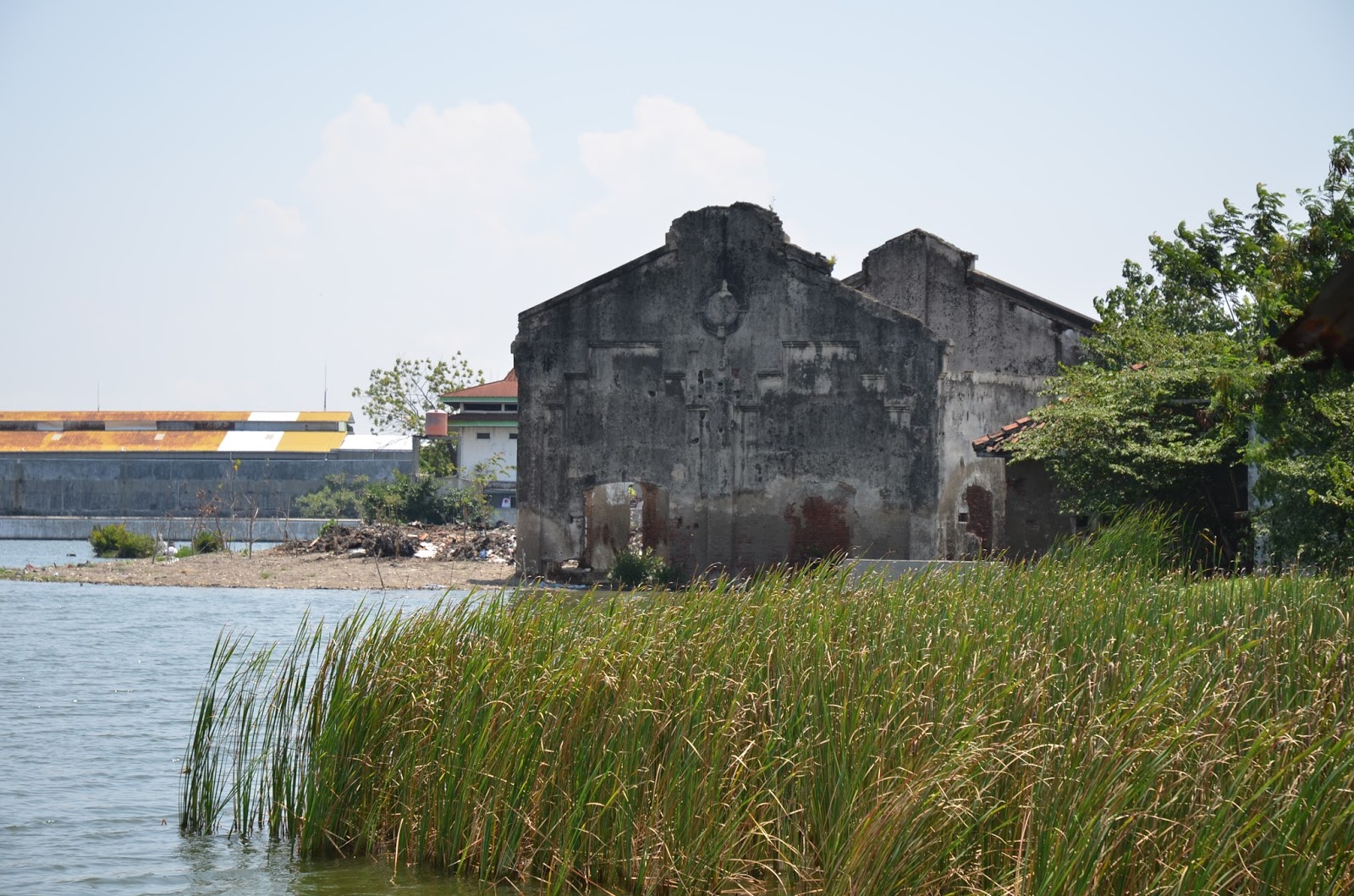
Halte Genoek, the place where the first Buitenlijnen (External lines) 
of SJS Tram services was inaugurated on July 23rd, 1883. The condition is 
getting worse because of land subsidence that can go up to 14–19 cm/year. 
(photos by: Abdul Hakim Nurmaulana)
Now, I'm gonna explain about SJS first, the source taken from the book titled De Tramwegen op Java, issued on 1907 in order to celebrated the 25 anniversary of SJS. SJS established on September 28th 1881 in Gravenhage, Netherlands. This company headed by Mr. M. A. H. Baron van der Goes of Dirxland. Firstly, this company get a concession to built tram network in the area of Semarang until Joana (Juwana) on March 18, 1881. So, SJS is the pioneer of the tram network in Java Island, as well as Indonesia. Seems like this company get a inspiration from the Netherlands which at that time also developed its tramwegen network, and prove as the good commuter services. The SJS also using the narrow-gauge railway, 1067mm. Its different from the NIS at that time that using standard-gauge railway, 1435mm on their line that lies from Semarang-Surakarta-Yogyakarta and also Kedungjati-Ambarawa. Narrow-gauge is thus often used in mountainous terrain, where the savings in civil engineering work can be substantial.

SJS succesfully inaugurated their first line of city tram on December 1st 1882, in Semarang. The network lies between Station Central Jurnatan until Djomblang Station along 5 km. Then not so long from its inaugurated the inter-city tramway connection, start from Semarang until Genoek Station, on July, 23rd 1883 and in the same year its reached Demak, on September, 27th 1883. All of the lines using steam tram locomotives for the rolling stock, because all the lines were designed for the tram locomotives. SJS using such a Beyer, Peacock & Co. trams, that specially built, or modified, to work on a street, or roadside, just like all of the lines condition of SJS have in the beginning. The tram services by SJS were using the B12 series locomotives, produced by NV. Werkspoor from Netherlands and also the same type produced by Beyer-Peacock, England. This locomotief have classification as 0-4-0 locomotives, which 0-4-0 represents one of the simplest possible types, that with two axles and four coupled wheels, all of which are driven.

SJS tram passing Bodjong Weg or currently known as Jalan Pemuda. In the
left its visible the building of Lawang Sewu, the NIS head office.
(source: Leiden University Library)
According to the book that I was mentioned before as the source of thic article, during the 25 years services of SJS in Java island on 1907, the company already had 389 Km railway track in total, and the services as follows. The first one is, The Semarang city tram services, after the initial line from Semarang Central to Jurnatan, then its completed into Station Saramang NIS, Kleine Boom (harbour), and the last one West Bandjir Kanaal that inaugurated on November 4th 1899. Its interesting to know, that the city tram is also integrated to the another station from different company, like to Station Samarang NIS that already mentioned above and on 1914 it will be also integrated with Semarang West Station, runs by SCS that served railways connection to the west like Pekalongan, Tegal, Cirebon, Batavia (Jakarta), etc. The second one is, Buitenlijnen or external lines, after firstly its inaugurated from Semarang Central to Genoek, then its completed the lines into Juwana, on April 18th, 1884, and extended to Lasem on May, 1st 1900. After that its also developed its services not only from Semarang-Juwana (Joana) like the name of the company but also to Tayu, Welahan, Blora (through Purwodadi), Gundih, Kradenan and Cepu.

The former SJS werkplats in Pengapon Semarang.
(Photos by: Adityo Cahyo) 
The rapid development of the SJS in the late of 19th century, its seems not such a glorious on the following years. This company obliged to close the Semarang city tram services on 1940, due to the high amount of high operational cost. Its understandable, while another city tram like in Batavia and Surabaya already developed the double tracks and also electrified the tram, in Semarang, SJS still using the single track rails that of course is not accomodate much tram schedule, also still using the high cost steam tram, that using teak wood as its fuel. After the independence of Indonesia, this SJS lines failed to compete with the modern transportation mode, like bus. The type of the SJS rails which is not so wide (only 50mm width) and the position of the tracks which is side by side with the main roads, makes the train couldnt runs in maximum speed. Then now, only Blora-Cepu and Ngrombo (Purwodadi)-Gundih as part of SJS line, is remains in services.

Friday, October 26, 2012

Religion Tolerance a la Kudus City

Al Aqsa Mosque or people recognize it as Masjid Menara Kudus, in 1940
(source: Tropenmuseum)

Hello World!
Happy Iedul Adha all! Yesterday we celebrated one’s of the holy day of a moslem, the symbol of sacrifice and  togetherness. During Iedul Adha, one things is important, that is qurban (sacrifice) itself, which in the holy Koran, we recognize that phopret Ibrahim (Abraham) had a recurring dream, in which Allah SWT was commanding him to offer his son, Ismail (Ishmael) as a sacrifice. Ibrahim felt so confuse whether he want to obey the God orders, but there’s no father in the world who have his heart to sacrificing his dear son.  But later when Ibrahim asked Ismail about this, Ismail replied, “ Insha Allah (God willingness), you’ll find me to be patient, just do what the Allah asked to you father”. After all Ibrahim realize orders to sacrificing his son, he blindfold his eyes when he cut Ismail throat. When he cut Ishmael's throat and removed the blindfold, he was surprised when found  Ismail was unharmed and and still alive! But he found a dead sheep which was slaughtered. Abraham had passed the test by his willingness to carry out Allah SWT order. Since that day, all the moslem who’ve been capable are have a duty to slaughter a cattle (cow, goat, sheep, camel, ram, buffalo) during Iedul Adha day, then later distributed to the poor people. That’s the origin of Iedul Adha, but I wanna share about the unique tradition in Kudus city, a city to the east of Semarang about this day.

The story teller, Hasan, experted
about the story about early Islam in Java
I got this story from my friends who comin’ from there named Hasan Anwar, he explain me about, why the Kudus people are forbidden to use cow as their qurban? Even not only on that celebration, we almost couldn’t find any soto, kind of Javanese soup, which using cow meat in Kudus, because they changed it with buffalo meat. So, whats the reason behind it?

Hasan, told me that its just because of Sunan Kudus, the pseudonym of Jaffar Shadiq, the early Islam missionary in Java who lived in Kudus, forbid the people to slaughtering cow, in order to respect the Hindu’s people, who at that time are the majority in Java island. One day, he received a cow coming from the merchant from India. The people are so curious when the cow is tethered in front of Sunan Kudus house. The hindu’s people want to know what will Sunan Kudus do, for the holy animal according to their belief. The number of people gathered increasing, both of the Hindu’s and Muslim’s, who want to  prevented, if any trouble happened to the Sunan Kudus. Then Sunan Kudus come out from his house and said, “Brothers and sisters! My beloved people, I’ll not do any danger to this cow, and I beg u not to hurt even slaughter the cow, because in my childhood this animal once saved my life, its nursing me when I was suffering due to really bad thirst. Even in our Koran, there’s a surah (chapter) using the name of this animal, called Al Baqarah (Baqarah: female cow). ”

Then the people are so excited with what the Sunan Kudus said. Its proof them about the high tolerance of moslem people. Even after that a lots of people converted to Islam, and Sunan Kudus according to the folkstale, received a granted, there’s a building from the local religious leader, where later he renovated it and nowadays become what we recognize as Masjid Menara Kudus.  Most of the building carried the Hindu’s architecture, dominated with the red bricks structure. Its always remind me about , the beauty of harmonism.

Well, until now, Kudus people still obeys the Sunan Kudus order not to slaughtering cow. Every Iedul Adha day, there’s no cow is slaughtered, only goat, sheep, and buffalo. Even Hasan’s added, “once there’s a kampong, break the rule, they slaughter the cow and later all of them were ill.” Believe it or not ;)    

Saturday, April 16, 2011

The story of Nitisemito, "The Kings of Kretek"

The Bal Tiga factory in Jati, Kudus around 1936 and the Bal Tiga logo's, the cigarettes brand founded by Nitisemito
Last Weekends, me and my friends from university, pay a visit to Kudus city, the city which is located around 70 km away to the east from Semarang. We did our assignment from Ekonomi Pertanian (Aggricultural Economics) subject to collecting data from Sugar cane farmer and also sugar factory in Kudus to complete our assignment. 1,5 hours ridin’ my motorbikes, finally i reached this city on 10pm, and this is my first time i’m ridin’ my motorbike outside the city of Semarang alone, hehe.

Well, i’m not going to share about my experience there, but there’s one story that really interested me. That is about the Kudus city is so famous for its cigarettes, so this city also called as “Kota Kretek” (The city of kretek). The kretek it self was found by the javanesse, but nowadays, only small number of javanesse company handled this business, the others was controlled by chinesse. In fact in the early of 20 century, there was a Javanesse Tycoon named Nitisemito that ruled this business. Even if we pray in the great mosque of Kudus actually, Pekalongan, Magelang, and another city in Middle Java especially, we could find a stand pendulum clock with a Nitisemito cigarettes company, “Bal Tiga” trade mark. Seems that all of this clock are Nitisemito’s company gift. So, who is actually this man? What is he and his company story? Well, lets figure out

Nitisemito born from an ambtenaar (civil officer) family on 1863. His Father was a regent in Kudus City. Not like the others peeps who born from its kind of family, Nitisemito choose himself as a businessman. Firstly his business on textile, then in the early of 1910, he start his business in cigarettes business named Bal Tiga Cigarette. He concern on Kretek type of cifgarettes. Well, This is why he called as “The King of Kretek”, eventhough the founder of its kind of cigarettes actually not him, but a Kudus people also named Jamhari.

On that age, Nitisemito was already invented a promotional for his product like a modern company. He used a gift to interested the consumers. A couple of Bal Tiga pack can be exchanged with a goods like plate, a clock, until a bike! Also he promote his product through carious media that available, mostly through newspaper. His business start ruled the cigarettes market. A lot of Kudus people say that he wan owned a large scale of land in the Menara Region, a region that located in the heart of Kudus city.

A pendulum Clock, a gift from Nitisemito
on Masjid Jami Pekalongan 
His business start to declined since the Chinesse-Javanesse Riot on Kudus on 1918. The riot started when the chinesse beated the javanesse people when some of the javanesse insulting the chinesse festival. Well, many peeps also said that the riot actually caused by a unhealthy business rivalry between businessmen. This riot that known as “Peroesohan di Koedoes”, its really affected to all sector of industries in Kudus city. Many of house, warehouse, and factory was burnt down. Many of javanesse businessman also being arrested by the colonial police because of many of them blamed as the provocatore, mostly the businessmen that incorporated with Sarekat Islam (SI)organization.

The Bal Tiga Company fortunately can survive from its hard period, but suddenly a big problem shocked this company. The colonial government accused the company embezzling tax, and also many rumours there were an internal affairs inside the company. The company was didn’t developed well as in the past, moreover during the Japanesse occupation. The stories of this Javanesse tycoon ended when he died on 1953, and no one of his descendant become his successor. But the histories cant be bears his named as one of the succesfull javanesse businessman. Like most of the Kudus people remembered him