Showing posts with label Railways. Show all posts

Wednesday, April 27, 2016

Semarang-Joana Stoomtram Maatschappij (SJS), the Pioneer of Steam Tram Development in Indonesia

The emplacement of  Semarang Central Station, owned by Semarang-Joana Stoomtram Maatschappij (SJS) in 1920. This central station served the city tram services as well as external lines to the cities to the east of Semarang. Unfortunately, nothings remains from this station after demolished in 80's decade. Source: Tropenmuseum
There was three major railway company in Semarang on the old days, Nederlandsch Indische Spoorweg Maatschappij (NIS), Semarang-Cheribon Stoomtram Maatschappij (SCS) and Semarang-Joana Stoomtram Maatschappij (SJS). NIS was the leading company at that time, its also became the company who built the first railways in Indonesia, or Dutch-Indies at that time. The main office of this company even much famous among the people nowadays, a building called Lawang Sewu means thousand doors. Also became landmark of Semarang city yet popular city destination. How about the rest? The SCS and SJS? Not so many people discussing about this two companies that also served the city of Semarang during the colonial period. After the independence of Indonesia, these company, NIS, SCS and SJS is amongst the eleven private railways company, together with the Staats Spoorwegen, the state railway company merged under Djawatan Kereta Api (DKA) Republik Indonesia on January 1st 1946. Currently the company change the name into PT. Kereta Api Indonesia (KAI).

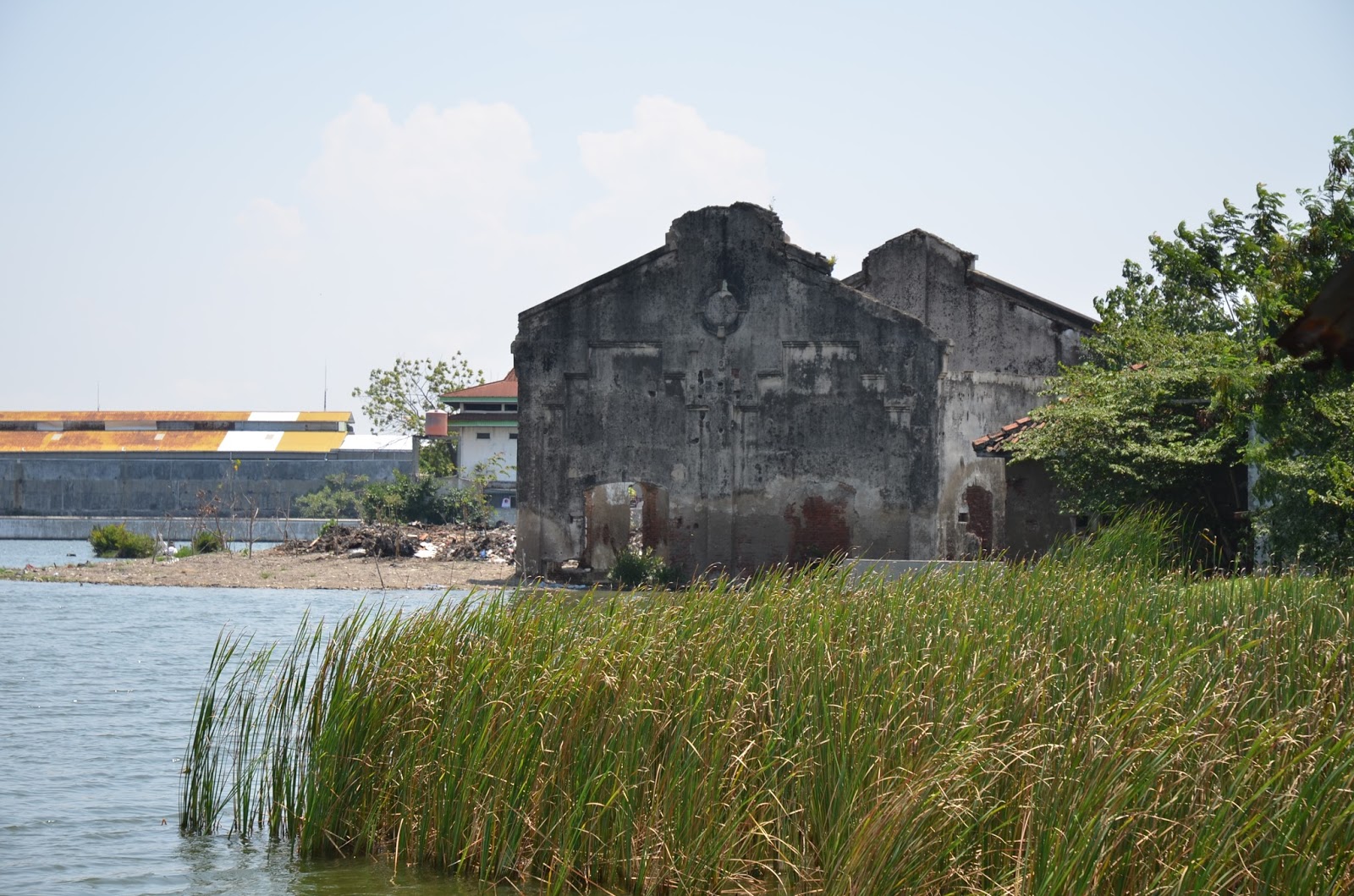
Halte Genoek, the place where the first Buitenlijnen (External lines) 
of SJS Tram services was inaugurated on July 23rd, 1883. The condition is 
getting worse because of land subsidence that can go up to 14–19 cm/year. 
(photos by: Abdul Hakim Nurmaulana)
Now, I'm gonna explain about SJS first, the source taken from the book titled De Tramwegen op Java, issued on 1907 in order to celebrated the 25 anniversary of SJS. SJS established on September 28th 1881 in Gravenhage, Netherlands. This company headed by Mr. M. A. H. Baron van der Goes of Dirxland. Firstly, this company get a concession to built tram network in the area of Semarang until Joana (Juwana) on March 18, 1881. So, SJS is the pioneer of the tram network in Java Island, as well as Indonesia. Seems like this company get a inspiration from the Netherlands which at that time also developed its tramwegen network, and prove as the good commuter services. The SJS also using the narrow-gauge railway, 1067mm. Its different from the NIS at that time that using standard-gauge railway, 1435mm on their line that lies from Semarang-Surakarta-Yogyakarta and also Kedungjati-Ambarawa. Narrow-gauge is thus often used in mountainous terrain, where the savings in civil engineering work can be substantial.

SJS succesfully inaugurated their first line of city tram on December 1st 1882, in Semarang. The network lies between Station Central Jurnatan until Djomblang Station along 5 km. Then not so long from its inaugurated the inter-city tramway connection, start from Semarang until Genoek Station, on July, 23rd 1883 and in the same year its reached Demak, on September, 27th 1883. All of the lines using steam tram locomotives for the rolling stock, because all the lines were designed for the tram locomotives. SJS using such a Beyer, Peacock & Co. trams, that specially built, or modified, to work on a street, or roadside, just like all of the lines condition of SJS have in the beginning. The tram services by SJS were using the B12 series locomotives, produced by NV. Werkspoor from Netherlands and also the same type produced by Beyer-Peacock, England. This locomotief have classification as 0-4-0 locomotives, which 0-4-0 represents one of the simplest possible types, that with two axles and four coupled wheels, all of which are driven.

SJS tram passing Bodjong Weg or currently known as Jalan Pemuda. In the
left its visible the building of Lawang Sewu, the NIS head office.
(source: Leiden University Library)
According to the book that I was mentioned before as the source of thic article, during the 25 years services of SJS in Java island on 1907, the company already had 389 Km railway track in total, and the services as follows. The first one is, The Semarang city tram services, after the initial line from Semarang Central to Jurnatan, then its completed into Station Saramang NIS, Kleine Boom (harbour), and the last one West Bandjir Kanaal that inaugurated on November 4th 1899. Its interesting to know, that the city tram is also integrated to the another station from different company, like to Station Samarang NIS that already mentioned above and on 1914 it will be also integrated with Semarang West Station, runs by SCS that served railways connection to the west like Pekalongan, Tegal, Cirebon, Batavia (Jakarta), etc. The second one is, Buitenlijnen or external lines, after firstly its inaugurated from Semarang Central to Genoek, then its completed the lines into Juwana, on April 18th, 1884, and extended to Lasem on May, 1st 1900. After that its also developed its services not only from Semarang-Juwana (Joana) like the name of the company but also to Tayu, Welahan, Blora (through Purwodadi), Gundih, Kradenan and Cepu.

The former SJS werkplats in Pengapon Semarang.
(Photos by: Adityo Cahyo
The rapid development of the SJS in the late of 19th century, its seems not such a glorious on the following years. This company obliged to close the Semarang city tram services on 1940, due to the high amount of high operational cost. Its understandable, while another city tram like in Batavia and Surabaya already developed the double tracks and also electrified the tram, in Semarang, SJS still using the single track rails that of course is not accomodate much tram schedule, also still using the high cost steam tram, that using teak wood as its fuel. After the independence of Indonesia, this SJS lines failed to compete with the modern transportation mode, like bus. The type of the SJS rails which is not so wide (only 50mm width) and the position of the tracks which is side by side with the main roads, makes the train couldnt runs in maximum speed. Then now, only Blora-Cepu and Ngrombo (Purwodadi)-Gundih as part of SJS line, is remains in services.

Saturday, January 18, 2014

Lasem Station, Application of City Identity

The Lasem Station building current condition, abandoned and decayed. The station emplacement now used as the truck parking yard and none of the railroad were remains. Here also available a videos from Nederlands Filmarchief about Station Lasem.
 Railways, a mass tranportation modes that here in Indonesia has been existed since 1867. Even now until this January, 21st in Lawang Sewu, held the exhibition about the History of Railways in Indonesia from time to time. For me, Railways is not only a locomotives hauled several carriage over the railroad, its also a matter of culture. How the railways development affected the society, the timelines educated people to disciplines, and also the construction of this infrastructure.

An information from Pak Tjahjono Rahardjo, a Railfans who also a cultural activist about the Station Lasem always made me curious. A station that the facade adopted the chinese houses shaped. If its true, I guess this were the second station that I know, built in Indonesia during the colonial age but not using the european style building, but the local building characteristic. The first one it was the Stasiun Solo Balapan in Solo, which adopted the luxurious taste of Javanese Joglo shaped building.

I got  so curious about this fact and realize that the station, in every city has its own characteristic based on where the station is belongs to. Here some examples like, adopted the Gereja Blenduk as city icon, perhaps made the Tawang Station in Semarang have its cupola as the roof in main hall.  In order to show about the importance and getting the title of one of the busiest port in Asia after the Suez Canal has been open, in Batavia (Jakarta) built the luxurious Tanjung  Priok station that its design of curve remind us to the King Cross Station, that used by Harry Potter series as its movie sets. But here in Lasem, the building adopted the surround architectures as the city with nicknames Le Petit Chinois, the little Chinese.

The lines here once belongs to Semarang Joana Stoomtram Maatschappij (SJS) that serve the railways connection between Semarang and Juwana, start in 1881. According to the sites of keretaapi.tripod.com, SJS  was the first of the 15 tramway companies in Java. The tramways were usually related to agricultural developments, especially sugar plantations and factories, tobacco and rubber plantations, and forestry. The lines also acted as feeder to the main lines. These tramways were built according to certain standards, allowing some exchange of rolling stock with the state railways, and some lines were indeed later upgraded to main-line railway standards.

Here in lasem, famous for its Batik craft product, this station must be the important things to distribute the Batik all over the major city in Java. In Semarang, the building of Gabungan Koperasi Batik Indonesia (Indonesian Batik Trading Society) situated not so far from the Jurnatan station, one’s of the station placed in the SJS lines of Semarang-Juwana, I believe its related.

Thanks anyway for Forum Komunikasi Masyarakat Sejarah (FOKMAS) Lasem mates, for take me here. Felt so glad to trace back the glory of Lasem city in a days, see you next mates! J

Wednesday, March 27, 2013

Jurnatan Heritage Site in Memoriam

On the leftside were aerial photos of Jurnatan Central Station, the Bank of Taiwan, and KNIMC. On the right side were the current condition, all of them were changed into shopping complex. (source: Wikimapia and Google Earth)
The development of a civilization can’t separated by the story from the past. That’s the importance of learning history, therefore the needs of acknowledgement of history plus the preservation of historical sites is the duties for those who were becoming a “successor” of a civilization. Here in Semarang, lack of the awareness truly jeopardized these, especially for the historical sites preservations efforts. But I think, its not only in Semarang but all over the world which belongs to development countries. It’s a common problems there, where’s the preservation efforts which related faced with the economics problems like,” how we could use it to fulfilling the daily needs?”. Commonly, they takes the short ways, to demolished it then changed into something that could give the high return in a short time. To built a residences or a business complex above it because of the needs are so high.

Jurnatan Centraal Station in 1927, the centre of tram services all around
Semarang. This station belongs to Samarang Joana Stoomtram-Maatschappij.
(Source: KITLV)
I’m gonna shared one’s of the biggest loss in Semarang, related to the Historical sites. It’s in the Jurnatan where once there’s a Jurnatan Station, Bank of Taiwan and Indische Motor Club building stood in this more than 10 acres large area, but now, no one’s survive. A business complex built above this area in the last decades of 80’s. The Jurnatan Station that owned by Semarang-Joana Stoomtram Maatschapijj are the biggest building here. This was the centre of City Tram services in Semarang which started in 1889.  The Tram services were closed under the Japanese occupation, and the Station converted into City Terminal in 1974, with still maintaining some parts of the station like the unique platform that decorated by stained glass decoration still preserved.  Around 1986, its completely demolished to built a newly business complex called Jurnatan Business Center. Here is the list of the notable buildings that lost in the area of Jurnatan.

1. Jurnatan Centraal Station, the Railways Station owned by Semarang Joana Stoomtram Maatschappij that served the line between Semarang until the North-Coast City (Indonesia: Pantai Utara or simply known as Pantura) like Demak, Kudus, Rembang, Pati, etc, also served the City Tram services in Semarang.
2. Insulinde Bike Factory.
3. Bank of Taiwan Office
4. Koninklijke Nederlands Indie Motor Club (KNIMC) Headquarters
5. Wurttembergische Kazerne
6. Centraal Gevangenis
7. Semarang Wees- en Boedelkamer (Weeskamer)

Wat Jammer! Just try to observed the aerial photos of these area were totally awesome and doesn’t make sense, how such that big area with the enormous buliding on it were demolished. Changed into such a unartistic building used as a business complex. Due to the low quality structure, currently most of the block on that sites were abandoned. Still felt so curious about the reason behind it anyway behind the destruction of this sites. but this was a proof that once u’ve false deciding something, it wouldn’t hard to changed its back, think twice before! ;)

Saturday, March 17, 2012

Het Trein Station te Toentang

Toentang Train Station from the North Sides in 1910-1915 (Source: Leiden University Library)


Tuntang is a small cities, belong to the Kabupaten Semarang administration. A small city that I visited when I took for a rest from my trip from Semarang to Salatiga several months ago. Then here we are, I took some photos from Toentang Station that have been deactived for more than 20 years. Toentang Station built together with the project of connecting Semarang and Yogyakarta trhough the railway system in 1873. This project were accomplished by Nederlandsch Indische Spoorweg Maatschappij (NISM) and resulting the one of the unique track between Jamboe and Bedono, that is climbing track, only a few survived in the world nowadays, included this one. Talking about Toentang Station, the big restoration is already done in order to reactivate this station. The government want to extend the tourism of steam locomotive track into the north, reactivate again Ambarawa-Kedungjati lines, that once lies in the Semarang-Yogyakarta lines. So that the tourist could enjoying the beautiful sceneries of lake Rawa Pening, because the railroad is situated along the edge of the lake itself

Toentang Train Station rear terrace
as arrival and departure boards
Talking About this city ,Tuntang having an important role during the British Invasion of Java in 1811 as the part of Napoleonic War, in the beginning of 19th century. The Kingdom of Holland was annexed to the First French Empire in 1810, and Java became the part of French colony, though it continued to be administered and defended primarily by Dutch personnel. The Kingdom of Holland armies, together with French armies after the several months of battle, started in Batavia then retreated to Bogor until its defeated in Jatingaleh, Semarang. The remains were runs to the south and finally surrendered to the Britons. Through the treaty in this city named Toentang Capitulation on 1811, the Java Island were fall in Britons hand. It was become the beginning of the British rule of Indonesia, until the next four years until 1815.

Here in this station that now were no longer crowded by the passenger for waiting for the train coming by. I felt the power of interactions on that time between the people in countryside with those on the city. Once, the development of railroad network have its purpose to fulfilling the needs of the people about transportation, also as an efforts to the better economic growth. Along the area which passed by railroad network, the people used this “metal horses” as their daily transport.  Furthermore, in many small station or halte located, the people from the countryside often exploit it as their means to sold their product,  the traders came from the countryside offering their product, dominated by agricultural products, and those from the city are also came with their product, dominated by factory product like clothes, shoes, and so on. The station once  become the important place for the rural and urban people to interact.


Imagined about the condition, the crowd, the people aroud it, then maybe this postcard picture, taken from collectiontrade.nl could represented, hows it looks-like...

Thursday, October 11, 2007

Lawang Sewu, De Voormalig NIS Kantooren

The Office of  Nederlandsch-Indische Spoorweg Maatschappij (NIS) or known as Lawang Sewu as it appears on 1930 and a medallion with the logo of NIS, issued as the NIS 50th anniversary on 1913.
(Source: Leiden University Library (photos)| devrieze (medallion)) 
Lawang Sewu or literally translated as the thousand door, is a most famous colonial heritage building in Semarang. The reason behind the name was the massives amount of its leaf doors. Together with Gereja Blenduk (Koepelkerk), Lawang Sewu also became a landmark of Semarang, although its really struggled to bear its reputation as one’s of the most haunted place in Semarang since its been neglected for dozen of years. The spooky reputation also widely known after a TV Shows of Dunia Lain, a cult hit in Indonesian reality show about intangible world that has a special part of Uji Nyali or test of courage. Here in Lawang Sewu in 2006, consider as the most terrifying episodes since these intangible creatures was appeared in on screen! Then its started to encourage people to experienced the same things here. Creepy!

Lawang Sewu inner courtyard in 2007, currently the building was empty
and badly neglected after the last time its in active used was in 1996.  
Then of course it has reduced the historical values of the building, people were not interested to how its built, how the story behind, or anything related to the heritage but the ghost story. The historical fact behind Lawang Sewu for me is far more interesting than those creepy story that most of the time been overrated. The building was an headquarters of Nederlandsch Indische Spoorweg Maatschappij (NIS), the leading of railway company in Netherlands East Indie, present-day Indonesia. NIS also the first company that established railway connection in Netherlands East Indie that connected Semarang-Tanggung in 1867. The company then succesfully established railway connection in from Semarang-Solo-Yogyakarta, included its branch route to Ambarawa in 1873.In the following year the railway line developed rapidly. In 1893, built the Yogyakarta - Brosot route that serves the network of sugar factory in the south, as well as Yogyakarta - Ambarawa route through Magelang and Secang with its famous rackrailway. The last route was built from Gundih to Surabaya Pasar Turi railway line along 245 kilometers. The rapid growth of NIS's rail network, by itself is followed by the increase number of employees. Thus the NIS office in Samarang station, no longer adequate to serves the vast growth of its employes. Then its started to plans the freshly new building as its new headquarters.

A city tram of Semarang passing through the Bodjong Weg, present-day
Jalan Pemuda that located in the north of Lawang Sewu.
(source: Tropenmuseum)
Two Dutch architect was appointed to design this new NIS headquarters, they were Professor Jakob F. Klinkhamer and BJ Ouendag.  The design was a two story building with a bit traditionalism style influence, a style that really emerge in Dutch architecture sphere during that period.  The design also referring to the tropical architectural design which its surrounded by a front and back hallway to protect buildings from direct sunlight as well as the raindrop during the rain season which most of the time will be very intense in the tropical area. As the NIS is a railway company, Klinkhamer and Ouendag try to response it into their design by placing the connecting door in the same lines between the room that made its look like in the train couch.

Klinkhamer and Ouendag never came to Semarang to execute the plans, but they appointed an in-house architect D.W. Hinse to carry out the building progress. On 27 February 1904, the first stone was laid down and soon Hinse found out that the ground condition was not good enough for the structure. He proposed an soil improvements and hardly convince the NIS board to fulfill His demand since its quite costly. But Hinse prevailed to convince them, so He execute His ideas to dug the areas of the construction 4 meters  deep and filled with vulcanic sands from surround Merapi mountain, the most active vulcano in Java. Later, this was the reason of the strength of the building that could last for more than hundreds year without any significant structure damage after all this time.


beautiful stained glass decoration in the main hall,
made by J.L. Schouten from the studio "Prinsenhof"
in the city of Delft
During the construction period, around 300 workers are deployed every day. The materials was also brought in directly from the Europe, such as its roof-tile and glazure bricks that cames from Venlo, Netherlands and the granite was imported from granite quarries in the mountains of Fichtel, Bavaria, Germany. About 350 m3 of granite stone has been carefully cut in mining location according to the size in the picture, so that when arriving in Semarang its ready to installed without any adjustments was necessary. Also, its very beautiful stained glass decoration in the main hall, made by J.L. Schouten from the studio "Prinsenhof" in the city of Delft. On July 1, 1907, the NIS office was completed, and its inaugurated without a big ceremony, only a simple selamatan was carry out as its part of the Javanese tradition to start a something new. On the 1916, NIS built a new building in the back to accomodate the number of employers. But the building was more modest and simple compare to the first building since its already used the concrete structure. Its completed in 1918 and became the last building to be built in the Lawang Sewu complex.