Wednesday, April 27, 2016

Semarang-Joana Stoomtram Maatschappij (SJS), the Pioneer of Steam Tram Development in Indonesia

The emplacement of  Semarang Central Station, owned by Semarang-Joana Stoomtram Maatschappij (SJS) in 1920. This central station served the city tram services as well as external lines to the cities to the east of Semarang. Unfortunately, nothings remains from this station after demolished in 80's decade. Source: Tropenmuseum
There was three major railway company in Semarang on the old days, Nederlandsch Indische Spoorweg Maatschappij (NIS), Semarang-Cheribon Stoomtram Maatschappij (SCS) and Semarang-Joana Stoomtram Maatschappij (SJS). NIS was the leading company at that time, its also became the company who built the first railways in Indonesia, or Dutch-Indies at that time. The main office of this company even much famous among the people nowadays, a building called Lawang Sewu means thousand doors. Also became landmark of Semarang city yet popular city destination. How about the rest? The SCS and SJS? Not so many people discussing about this two companies that also served the city of Semarang during the colonial period. After the independence of Indonesia, these company, NIS, SCS and SJS is amongst the eleven private railways company, together with the Staats Spoorwegen, the state railway company merged under Djawatan Kereta Api (DKA) Republik Indonesia on January 1st 1946. Currently the company change the name into PT. Kereta Api Indonesia (KAI).

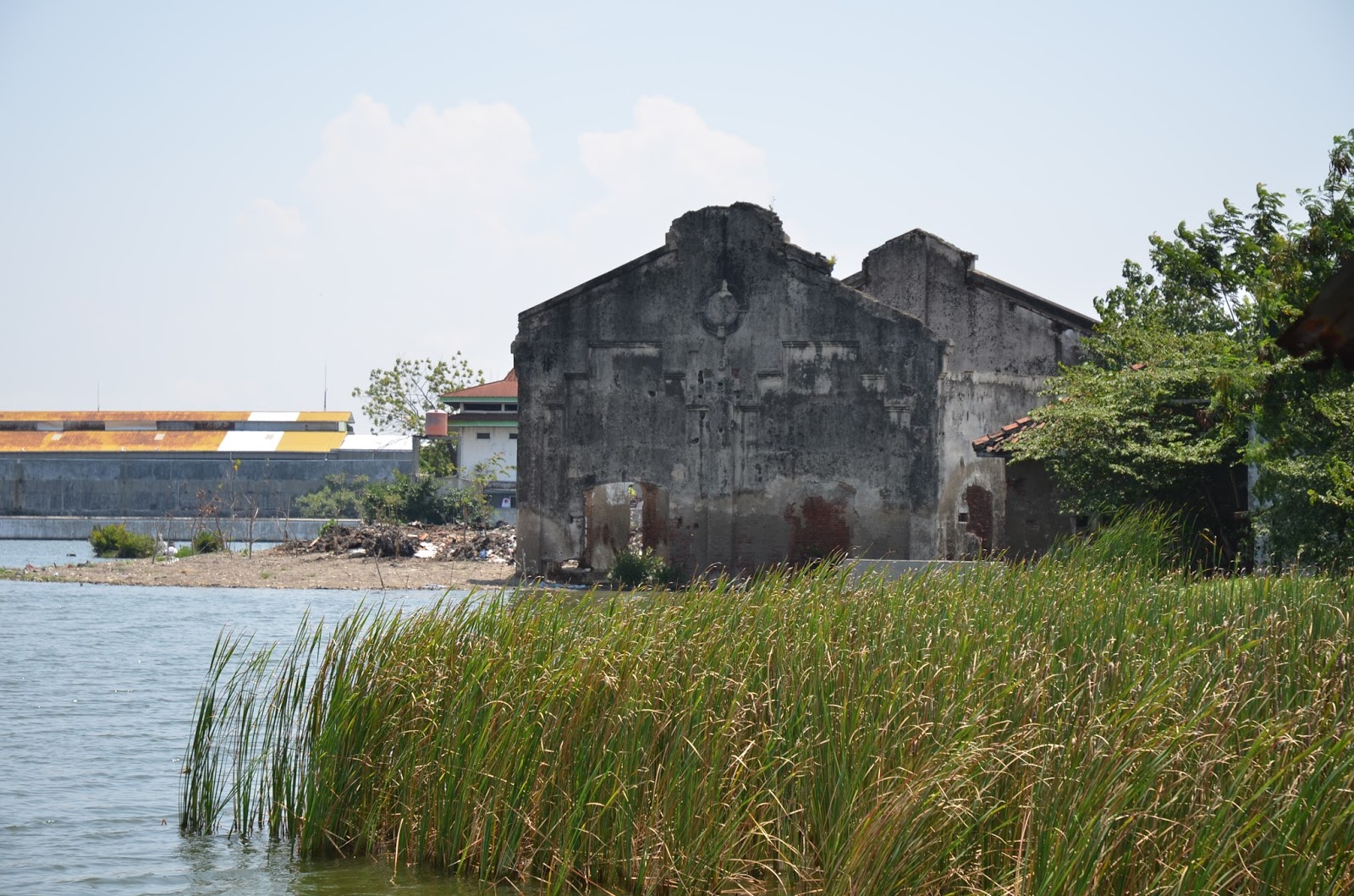
Halte Genoek, the place where the first Buitenlijnen (External lines) 
of SJS Tram services was inaugurated on July 23rd, 1883. The condition is 
getting worse because of land subsidence that can go up to 14–19 cm/year. 
(photos by: Abdul Hakim Nurmaulana)
Now, I'm gonna explain about SJS first, the source taken from the book titled De Tramwegen op Java, issued on 1907 in order to celebrated the 25 anniversary of SJS. SJS established on September 28th 1881 in Gravenhage, Netherlands. This company headed by Mr. M. A. H. Baron van der Goes of Dirxland. Firstly, this company get a concession to built tram network in the area of Semarang until Joana (Juwana) on March 18, 1881. So, SJS is the pioneer of the tram network in Java Island, as well as Indonesia. Seems like this company get a inspiration from the Netherlands which at that time also developed its tramwegen network, and prove as the good commuter services. The SJS also using the narrow-gauge railway, 1067mm. Its different from the NIS at that time that using standard-gauge railway, 1435mm on their line that lies from Semarang-Surakarta-Yogyakarta and also Kedungjati-Ambarawa. Narrow-gauge is thus often used in mountainous terrain, where the savings in civil engineering work can be substantial.

SJS succesfully inaugurated their first line of city tram on December 1st 1882, in Semarang. The network lies between Station Central Jurnatan until Djomblang Station along 5 km. Then not so long from its inaugurated the inter-city tramway connection, start from Semarang until Genoek Station, on July, 23rd 1883 and in the same year its reached Demak, on September, 27th 1883. All of the lines using steam tram locomotives for the rolling stock, because all the lines were designed for the tram locomotives. SJS using such a Beyer, Peacock & Co. trams, that specially built, or modified, to work on a street, or roadside, just like all of the lines condition of SJS have in the beginning. The tram services by SJS were using the B12 series locomotives, produced by NV. Werkspoor from Netherlands and also the same type produced by Beyer-Peacock, England. This locomotief have classification as 0-4-0 locomotives, which 0-4-0 represents one of the simplest possible types, that with two axles and four coupled wheels, all of which are driven.

SJS tram passing Bodjong Weg or currently known as Jalan Pemuda. In the
left its visible the building of Lawang Sewu, the NIS head office.
(source: Leiden University Library)
According to the book that I was mentioned before as the source of thic article, during the 25 years services of SJS in Java island on 1907, the company already had 389 Km railway track in total, and the services as follows. The first one is, The Semarang city tram services, after the initial line from Semarang Central to Jurnatan, then its completed into Station Saramang NIS, Kleine Boom (harbour), and the last one West Bandjir Kanaal that inaugurated on November 4th 1899. Its interesting to know, that the city tram is also integrated to the another station from different company, like to Station Samarang NIS that already mentioned above and on 1914 it will be also integrated with Semarang West Station, runs by SCS that served railways connection to the west like Pekalongan, Tegal, Cirebon, Batavia (Jakarta), etc. The second one is, Buitenlijnen or external lines, after firstly its inaugurated from Semarang Central to Genoek, then its completed the lines into Juwana, on April 18th, 1884, and extended to Lasem on May, 1st 1900. After that its also developed its services not only from Semarang-Juwana (Joana) like the name of the company but also to Tayu, Welahan, Blora (through Purwodadi), Gundih, Kradenan and Cepu.

The former SJS werkplats in Pengapon Semarang.
(Photos by: Adityo Cahyo) 
The rapid development of the SJS in the late of 19th century, its seems not such a glorious on the following years. This company obliged to close the Semarang city tram services on 1940, due to the high amount of high operational cost. Its understandable, while another city tram like in Batavia and Surabaya already developed the double tracks and also electrified the tram, in Semarang, SJS still using the single track rails that of course is not accomodate much tram schedule, also still using the high cost steam tram, that using teak wood as its fuel. After the independence of Indonesia, this SJS lines failed to compete with the modern transportation mode, like bus. The type of the SJS rails which is not so wide (only 50mm width) and the position of the tracks which is side by side with the main roads, makes the train couldnt runs in maximum speed. Then now, only Blora-Cepu and Ngrombo (Purwodadi)-Gundih as part of SJS line, is remains in services.

Monday, January 25, 2016

The Englishman in Semarang

Thomas Whittecombe paintings about the Capture of Maria 
Riggersbergen, a Dutch frigate with 36 guns, in the port of 
Batavia as a part of Napoleonic Wars. (source: wikimedia)
The history relation between British and Indonesia have been so long created. In the literature we simply could found about the story about Sir Francis Drake reached Moluccas in 1579 on his circum-globe journey, which supposed to be the first Englishman officialy exploring Indonesia. Then also the story about their post in Banda in 18th century that then its sacked by Jan Pieterzon Coen, the exchanging between Pulau Run and Nieuw Amsterdam (Currently New York) through the Treaty of Breda in 1667, and also during the Napoleonic War, the British taken the DutchIndies, and creating such a notable person, Governor General in Java from 1812-1816, Sir Stamford Raffles with His famous book, The History of Java published in 1817. Then I am wondering as always, how about the story about the British peoples/company in Semarang?

Semarang Map in 1920, issued by NILLMIJ depicted two British Company in Semarang. Their office is situated in Oude Stadhuisstraat (now Jalan Branjangan) in Kota Lama (Old Town) neigborhood, and the company name is MacLaine & Co. and McNeill & Co. According to G. Roger Knight books titled Trade and Empire in Early Nineteenth-centtury South East Asia: Gillian MacLaine and His Business Network, there was a notable English company in Dutch Indies,  Maclaine & Co., an English trading company that established by Gillian Maclaine and Edward Watson in 1822. MacLaine's coming to Dutch Indies in actually earlier, even in 1821 Gillian Maclaine involved in a scheme hatched during the course of 1821 to rent further and very large tract of land for coffee growing from the ruler of Surakarta. After the establishment of Maclaine & Co. the business still related with the coffee, to became an export commodities. MacLaine & Co. beside growing its own coffee in their plantation in Melambong and Getas villages, both nearby Salatiga which also doing a coffee-buying to the others plantation, to accomodate the needs of export. In 1823, they opened their agents office in Semarang. Later Maclaine joined with the Scottisch owned company, McNeill & Co. one of firms that came to comprise the group of Asia-based enterprise that formed core of Maclaine Watson network. Thus, this two company having a same office building in Semarang. Their office even became the British Consulate in Semarang, its also depicted on the same map, as its mentioned before.

The opening of the first Jaarmaarkt in Semarang 1908, an exposition about the business potential in Semarang and its surround.  D.M. Campbell as the Head McNeill & Co. in Semarang sitting in second position from the right.
(source: Leiden University Library)

But then not so far from the MacLaine & Co. and McNeill & Co. office, there is another British company office. The insurance company named Liverpool & London & Globe Insurance Co. established their representation office in Semarang, also in Oude Stadhuisstraat. Date back to 1836, the year the Liverpool Fire and Life Insurance was established, within a few years, through several acquisitions, it became a prominent actor in the insurance sector. Among these companies taken over was the London, Edinburgh & Dublin Insurance Company in 1847. In 1864, following a successful bid for the Globe Insurance Company, a London-based insurer founded in 1803, the company then became The Liverpool & London & Globe. The Liverpool & London & Globe had a strong presence not only in the UK, where it was one of the main insurance companies, but also in the British empire, especially in Canada, Australia and New Zealand, and even in the US, where its first branches had opened in 1848. In 1919 the Liverpool & London & Globe was acquired by The Royal, a company based in Liverpool and one of the greatest British exporters of insurance, in what was the largest merger in British insurance history. But then in 1919, the company acquired by the Royal Insurance group until the 1996, when the merger between this company and the Sun Alliance changed the name again into Royal & Sun Alliance Insurance, and started from 2008 its simplified the name into RSAInsurance Group, until now.


An effort to preserved the marble plaque of Liverpool & London & Globe
Insurance in Kota Lama, January 17th 2016. Behind that, still visible
the remains of the remains letter configuration forming Roode Driehook,
that makes the people misinterpretated about the name of the building. 
Still dont know when the company is left from Indonesia, but the big possibilities its also nationalized during the early stage of the Indonesia indepence. The building of Liverpool & London & Globe Insurance  always mistaken as the Roode Driehook, since likely for the needs of the movie set in Kota Lama, the creative team placing a sign name Roode Driehook in the walls of the building. The words sounds so dutch, and the people thoght that its named as Roode Driehook since the establishment of this building. Also, its became one’s of the favourite place to taken photos since the Kota Lama now became one’s of the tourism destination in Semarang. But still, the acknowledgement of the building remains unimportant for most of the visitor, even the plaque that stated if the building is the office of Liverpool & London & Globe Insurance was heavily damaged by the vandalism, but on January 17th 2016, its cleaned by Lopen Semarang History Community. Actually, its already twice We cleaned this marble plaque from the vandalism, wish it will be the last time for Us to clean it up. 

Thursday, January 21, 2016

Jatingaleh, The Waterloo van Java

The Waterloo Plein, now known as Lapangan Banteng in Jakarta. Its named after the White Monument with The Lion Statue on the top of it to commemorate the Prince of Orange (later  reigning as Willam II of Netherlands) who take a part on Waterloo Battle in 1815. The monument then torned down during the Japanese occupation.
(source:Leiden University Library)
The British Troops invaded the Dutch Indies on March, 1811 from India as a part of Napoleonic War. The Netherlands had been controlled by France for several years and was already at war with Britain. Thus, Dutch Indies, now is under the French rules and also became the enemy of the Britons. If in Europe its well known the Waterloo as the last battle of the French against the Coalition Army, ending the Napoleonic War in Europe, here in Semarang, actually there’s a Jatingaleh Battle, the last major battle before the Dutch Indies officialy all into the British hands.

The tombstone of Liutenant-Colonel William
Campbell, of His Britannic Majesty’s
78th Regiment in All-Saint Anglican Church
Jakarta. Campbell died on August 28th 1811
during the Siege of Meester Cornelis.
After the failure to repeled the British attack at Meester Cornelis (nowadays Jatinegara, Jakarta), General Jansens and His troops were escaping to Semarang. Semarang at that time is already became the principal central station of the Java Island, belongs as a large town, with a considerable European population. It is defended by a stone parapet and rampart, with bastions, and a wet ditch, but only calculated for defence against a native power. Here in Semarang, Jansens had collected a considerable force, principally from the native prince. Among whoms, were Prince Prang Wedono (Mangkunegara II) who have a strength 1500 men well trained army called Legion Mangkoenegaran. This is the first regular army in western style in owns by native kingdoms, who established in 1808 and its likely inspired by French Grande Armee.

The British troops chasing the Jansens retreat to Semarang, led by Captain Maxwell, this “Red Coats” army were sailed to Semarang on September 10th 1811. On th September 13th the British troops, now under the command of Colonel Gibbs, landed at Semarang, but then realized that the French Troops is already abandoned the city. The Jansens were made a last attempt to repels the British attack in the hilly and difficult terrain in south of Semarang, Gombel Hill. The Jansens has choosed the battlefield were He can takes the advantages of this hilly terrain and the flanks of the position were protected by the extreme difficulty of the approach, and could not be turned in any other way than by a road of many miles through an intricate country. The road toward Gombel  itself  which is part of the main road to Solo, were barried with many chevaux de frise, a medieval defensive anti-cavalry measure consisting of a portable frame (sometimes just a simple log) covered with many projecting long iron or wooden spikes or spears. Jansens also prepared thirty pieces of cannon, regularly placed on platform. Almost impossible the British troops could beat them in such this condition, but on the other hands, a lots of the French army under Jansens were tiresome of the battle. Many of the army were actually the Dutch army that due to their country were occupied by the French, so now they served into the French Army. For them its not make sense to fights to the death against the British Army superiority, because of actually they were not fights for their homelands, but for their country occupants, the French.   

An aerial photos from Leiden University Library archives depicted the Djatingaleh KNIL kampement (now used as military facilities of Batalion ARHANUDSE, an Air Defence Artillery Department ) in 1930-1932. Comparing with the sketch of enemy position in the William Thorns books titled Conquest of Java, the X sign above is the position of French Troops in Gombel Hill, and the X below is the position of Jatingaleh valley (on the sketch is spelled as Jatty Nallee). Now the valley is built a highway that became a part of Semarang Toll Road . 
September 16th 1811, at two o’clock in the afternoon, Colonel Gibbs moved their troops to attacking the French position in Jatingaleh. About 1200 firelock (muzzle-loading firearm) and six guns were prepared for this. The Colonel halted in fornt of the position before the dawn, in order to reconnoitre, which was essentially necessary previous to an assault, as no information,  on which any reliance was to be placed, could be obtained at Semarang. A detachment with two guns, was sent to occupy a hill, which appeared to overlook the left of the enemy line. The remaining guns were brought to throw shot at a great elevation accros the vallet into the French Troops position. Soon as the guns were firing at the enemy position, Colonel Gibbs rushed accross the valley and up to the main road till they nearly reached the summit of the hill. They halted and allow the main body to advance. The enemy was surprised, they even didnt open fire till the British Troops under shelter.The British Troops the crossing the Valley of Jatingaleh, Colonel Gibbs ordering general advance on the enemy position. 

British Redcoat uniforms,
by Cpt. R.H.Raymond Smythies, 1894
The French Troops now distracted their collumns, leaving their guns behind and retreating in all directions. Its all proved that the discipline and the morality of the French Troops in the lowest level during the whole battle in Java. Comparing to the Siege of Meester Cornelis that in total British Troops lost 156 of his men , 788 wounded and 16 missing in August 27th 1811, this battle was nothing. Some sources account that only the Legion Mangkoenegaran maintain their disciplines, but soon its also crushed by the Red Coats. Jansens fleed to the south, to Fort of Salatiga and finding himself totally deserted by His men. He sent the same night a request to the British Troops for a cessations of arms and an offer to treat for a capitulation. The request were sent to the Liutenant General Sir Samuel Auchmuty, that  saw this is the chance for the British Troops to shortened the conquest of Java, even the British Army still preparing to taken the city of Surabaya, another major harbour city in Java. The capitulation finaly taken place at Tuntang, a small city in the west of Salatiga on September 18th 1811. After that, the Dutch Indies, now is officialy under the "Union Jack", and on October 11th 1811, the Lord Minto, the Governor General of India appointed Sir Stamford Raffles as the Governor General of Java.  

Source: The Conquest of Java by William Thorns

Friday, January 8, 2016

Semarang Weeskamer, Served The Cities for Almost Hundred of Year

Semarang Wees- en Boedelkamer buildings in 1910. (source: Leiden University Library)

It was institution named Wees- en Boedelkamers, means the board in charge of orphans and property in trust. Nowadays, we known this institution changed the name into Lembaga Balai Harta Peninggalan, in Semarang, located in Jalan Hanoman 25. This institution is under the Ministry of Law and Human Rights, and one’s of the oldest institution that still running its role nowadays. Wess en Boedelkamer or also known as Weeskamer is established during the period of Vereenigde Oost Indische Compagnie (VOC), in the 17th century.  At that times, there is needs for the population, especially among the Dutch people, to takes care of their wealth that about inheritable to their heirs, either here in Dutch Indies, or in Netherlands, for the orphaned childern, and so on.Thus they formed the Wesskamer institution on October 1st, 1624, in Jakarta under the rule of Pieter de Carpentier as the Governor-General of Dutch Indies.

Charles Ferdinand Pahud, Governor General
of  Dutch Indies 1856-1861.
Here in Semarang, the Weeskamer is established in May 17th 1763. Through the Weeskamer, the wealth of every citizens in a city is recorded, as well about their private life, likely a civil administration role at this time. Yap, Dutch people having a good reputation in about these administratie thingy. Here, in the Weeskamer of Semarang, there’s a story about Daniel Abraham Ferdinand Pahud, that became the Head of this institutions in the early of 19th century. His sons, Charles Ferdinand Pahud later became Governor-General of Dutch Indies from  1856-1861. Under His rules in Dutch Indies, the slavery were abolished in 1860.

But where’s the location of the Weeskamer buildings in Semarang? Just like nowadays, the institution is under the Ministry of Law and Human Rights, at that time the Weeskamer commonly situated near the Courts facilities. Here in Semarang, the Weeskamer is located next to the Centraal Gevangenis, the major prison in Semarang, in Jurnatan. Unfortunately, there’s no proof anymore about this building. The building has long time ago demolished, just like my post here before, that Jurnatan, is one’s of the biggest loss in Semarang, related to the Historical sites. Above the sites now is turned into the busy business district. 
Komplek Pertokoan Jurnatan, one's of the busiest business district in Semarang, built above the sites of demolished Weeskamer of Semarang and also the Centraal Gevangenis of Semarang.